
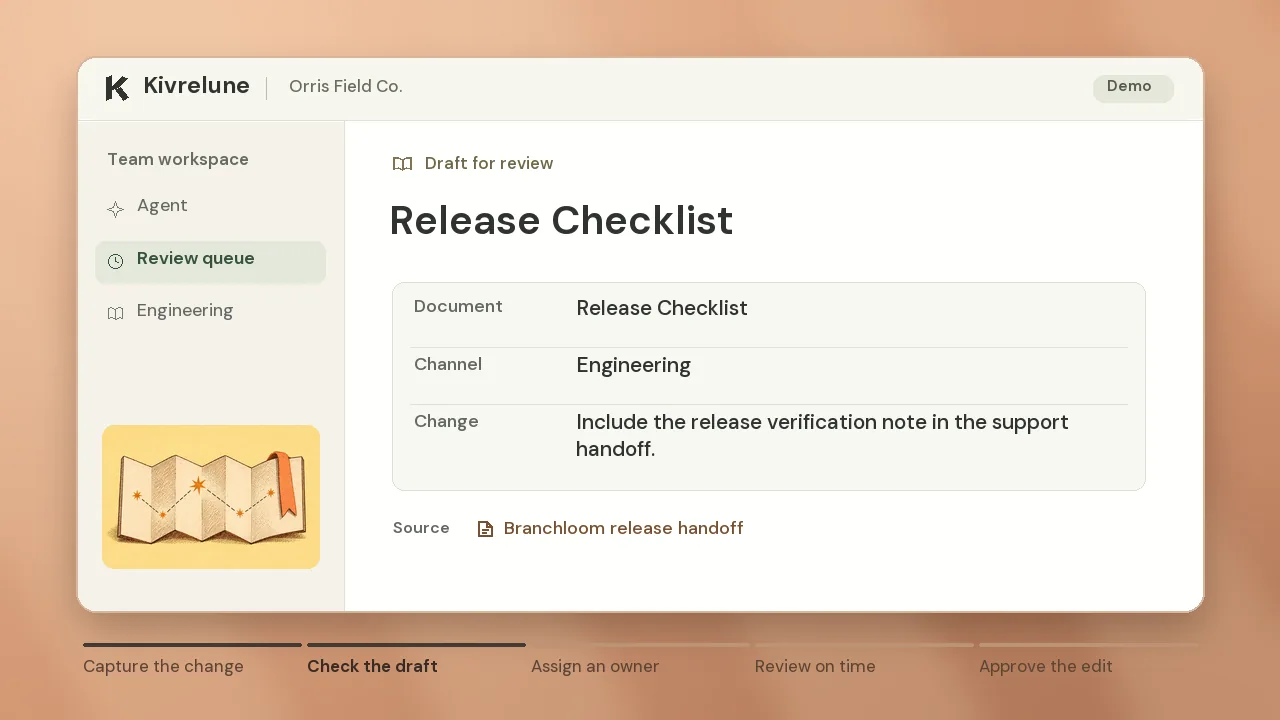
The release lead starts including the verification result in every handoff. A week later, someone follows the old checklist and Support gets a version number with no indication that the rollout passed.
The checklist needs a small correction. Finding it means reading a recent release note alongside the instructions people still use.
What is self-maintaining documentation?
A self-maintaining document has a recurring source check and a person responsible for the result. When a newer record disagrees with a published instruction, the owner sees both passages and decides how the page should change.
How it works
Check the document against recent work
Open the Release Checklist and read its handoff instructions beside the latest release note. Compare one claim at a time so a short correction stays attached to the evidence for it.
 Kivrelune
Review the proposed wording
The action in this example is specific. Add the verification result to the Support handoff. Read the original and proposed versions together, then accept the edit or send it back with a question.
Send the decision to the right owner
The release lead can confirm what should happen after rollout. Assign that role to the page so a future change reaches someone with enough context to make the call.
Choose when to run the check again
A frequently used checklist deserves a review timed to the release cycle. Keep the owner on the recurring check so that each suggestion has a clear destination.
Which pages benefit from a recurring check?
- Technical runbooks. Verify the recovery steps after a service or deployment procedure changes.
- Support procedures. Compare troubleshooting instructions with the fixes the team actually uses.
- People policies. Check dates, contacts and approval steps when responsibilities move.
- New-hire guides. Catch old access instructions before the next person joins.
Review related pages together
A change to the release process may affect the support handbook as well as the engineering checklist. Read both before closing the review and give each owner the part that belongs to their team.
What changes for your team
- A visible reason for an edit. Readers can trace the new wording to the handoff that prompted it.
- A review queue with specific decisions. Owners examine a proposed correction and its evidence together.
- A record the next shift can use. The approved checklist carries the release details forward to Support.
Open the release checklist in the sample workspace.
FAQ
Who makes the final decision on a suggested edit?
The page owner reviews the source and the proposed wording. In the Kivrelune workspace you can try that review on a sample document.
How does this fit with automated documentation?
Drafting creates a first page from existing records. Recurring checks compare that page with newer evidence and bring any changes back to its owner.
Explore automated documentation